
.webp)
.webp)
.webp)
/
December 9, 2025
Why Agents Need Onchain Privacy

.png)
Autonomous agents are no longer a thought experiment. Trading bots, shopping assistants,, and infrastructure agents are already moving value, triggering payments, and managing resources on their own. As x402-style and MachinePay flows emerge, these systems increasingly need to live onchain so their actions are verifiable, composable, and programmable.
The catch: most of this activity is landing on public chains that were designed for transparency first, not for autonomous competition.
The Transparency Trap: A Roadblock for Agent Execution
On public blockchains, every transaction passes through a visible mempool and every state change is permanently transparent. For agents that run 24/7 strategies, handle user data, and control capital, that means:
- Broadcasting their next move before it executes
- Revealing internal logic through transaction patterns
- Leaking sensitive user and business information on a public ledger
What started as “nice for auditability” becomes a structural roadblock to reliable, autonomous execution. You can’t ask agents to compete, coordinate, and manage serious value while forcing them to operate with their playbook fully exposed.
Why Agents Can’t Scale Without Privacy
At a small scale, agents can get away with operating in the open. But once they’re managing real capital, running proprietary strategies, or touching sensitive user and business data, privacy becomes the prerequisite for serious adoption. It’s what lets teams, enterprises, and users trust agents enough to put meaningful value behind them.
Without privacy for agents:
- Every profitable action is visible before it executes, MEV bots and competitors will harvest that value first. Over time, agents that can’t hide intent become unprofitable, and no one will fund or maintain them at scale.
- An agent’s behavior, thresholds, and routing logic can be read off the chain and cloned. That destroys competitive moat and turns sophisticated agents into public templates, which kills the incentive to invest in better models and infrastructure.
- Agents that expose spending patterns, subscriptions, locations, or business terms onchain will face user backlash and regulatory risk. Consumers and enterprises won’t route critical workflows through agents that effectively dox them by design.
Without privacy, agents remain small experiments. With privacy, they can safely manage serious value, sensitive data, and real-world operations. The real question becomes: where do these agents actually get that kind of privacy onchain?
SKALE: The Private Execution Layer Agents Need
SKALE is the answer to that question. It’s an execution layer that provides the core principles that agents need: private, MEV-resistant, gasless, instant transactions.
With BITE, SKALE Expand, and SKALE on Base, SKALE gives agents a dedicated private execution environment inside major EVM ecosystems, starting with Base. Agents don’t have to choose between privacy and composability or liquidity, they get both.
.png)
BITE Protocol: Encryption that Gives Agents Private Execution
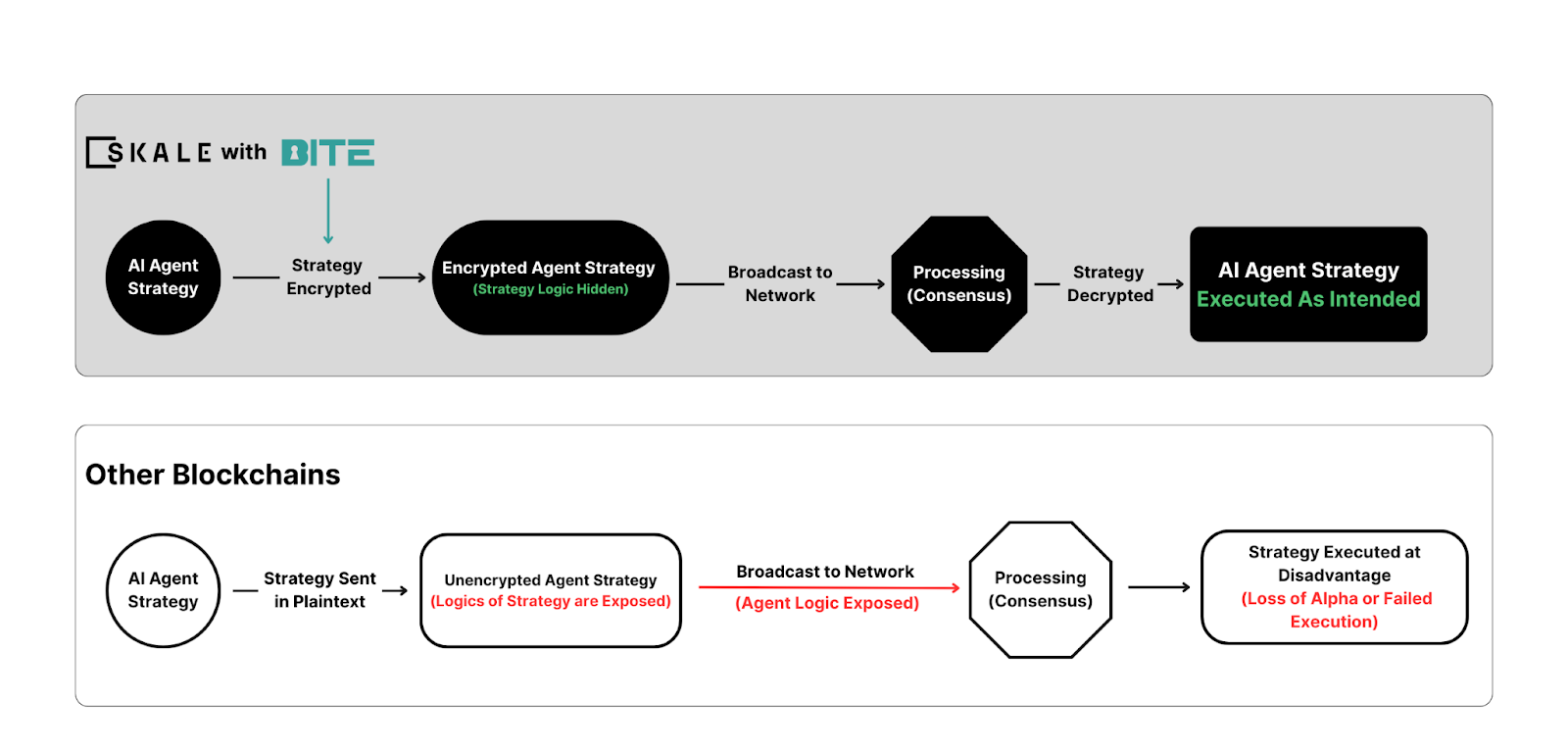
BITE (Blockchain Integrated Threshold Encryption) brings end-to-end encrypted transactions to SKALE chains:
- Transactions are encrypted before they’re broadcast
- Validators reach consensus on the encrypted payload
- Only after finalization are contents decrypted onchain
This removes the mempool visibility window, so searchers and attackers can’t see strategy, balances, or intent in advance. Agent operations stay confidential while still being fully onchain, creating a true private execution environment.
How Privacy Unlocks Real-World Agent Use Cases
SKALE’s private execution isn’t abstract; it changes what you can safely deploy:
Trading & Market Agents
Trading, rebalancing, and market-making agents need to scan markets and route orders without leaking their edge. Encrypted intent and execution paths let agents rebalance, arb, and provide liquidity while keeping positions, price thresholds, and venue routing hidden until after execution.
Commerce & Consumer Agents
Shopping, bill-pay, and personal finance agents coordinate payments and offers based on highly sensitive user behavior. Private execution keeps a user’s purchase history, subscriptions, and spending patterns encoded in agent logic rather than exposed onchain, so personalization doesn’t turn into public profiling.
DePIN & Infrastructure Agents
DePIN and IoT agents allocate scarce resources on the fly.Confidential pricing and utilization data let these agents run dynamic pricing and routing while keeping demand patterns, margins, and operational strategies shielded from competitors.
SKALE Expand & SKALE on Base: Privacy Where Liquidity Lives
Privacy isn’t useful if you have to leave the ecosystems where users and liquidity live. SKALE Expand solves that by deploying SKALE’s Manager contracts (and thus SKALE chains) directly into other EVM networks like Base.
- SKALE chains run inside these ecosystems
- Agents get SKALE’s private, gasless, instant execution
- Apps stay plugged into local users, onramps, and liquidity
SKALE on Base is the first Expand deployment: an agent-focused SKALE chain inside the Base ecosystem. Agents remain native to Base’s liquidity and distribution while executing on SKALE’s encrypted, gas-free, instant-finality infrastructure.
Compute is funded via Credits in USDC or SKL on Base, so agents transact with zero gas, private execution, and MEV resistance, making SKALE on Base a natural home for x402 payments and MachinePay flows.
Beyond Privacy: Performance Features Agents Depend On
Privacy is the foundation, but agents also need performance that matches real-world workloads. SKALE delivers:
- Gasless by design - Users and agents never manage gas. Apps prepay for compute with Credits, so interactions feel like Web2 while settling onchain.
- Instant finality - SKALE confirms transactions in under a second, so agent loops, payments, and access checks can run in near real time.
- High throughput - SKALE chains are optimized for high-volume, always-on use cases like agents, gaming, and DePIN.
- EVM-native - Through SKALE Expand, the same agent code can run across many EVM ecosystems, starting with Base, without relearning gas models.
If the future is an Internet of Agents, those agents need a private execution environment that actually matches how they operate: fast, gasless, MEV-resistant, and close to liquidity. That’s exactly what SKALE, BITE, SKALE Expand, and SKALE on Base are built to provide.


.svg)
.svg)

