
.webp)
.webp)
.webp)
What Is an x402 Facilitator?

.png)
The way payments are conducted on the internet is gradually changing, moving away from human interaction towards software agents that send payments to one another. The x402 standard is a central element driving this transition to agentic payments, with facilitators acting as the essential, often unnoticed, mechanism that enables its practical application.
Quick refresher: what is x402?
x402 is an agentic payment protocol that finally puts the long‑reserved HTTP status code 402 Payment Required to use. Instead of accounts, API keys, or subscription dashboards, a server can simply say:
“This endpoint costs $0.01 in USDC. Here’s where to pay.”
It does this by replying with a 402 and a small JSON payload when a request arrives without payment. The client (which might be an AI agent or a normal app) signs a short payment message, retries the request with that attached, and if the payment checks out, the server provides the requested resource, and gets paid.
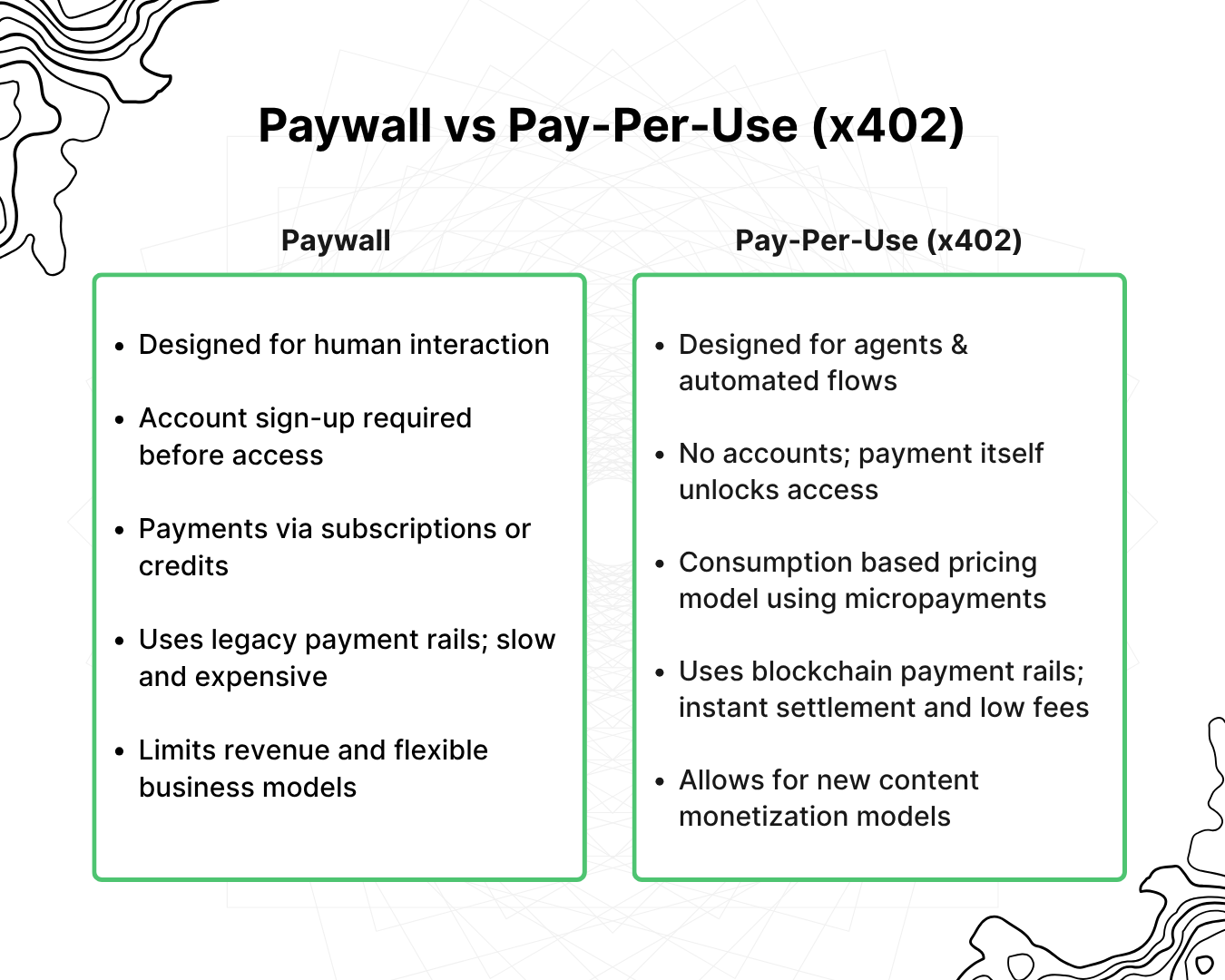
x402 changes how payments work on the internet. It allows any agent to pay-per-use for APIs, storage, compute, or content, without setting up accounts subscriptions, or otherwise needing human intervention
What is an x402 Facilitator?
A x402 facilitator is a service that verifies a payment request, and then actually moves the money onchain, on behalf of your application.
You can think of it as the onchain equivalent of a payment processor:
- On one side it talks HTTP to your API or website.
- On the other side it talks to the blockchain and the token contracts.
It’s technically optional, but in practice most serious x402 setups end up using a facilitator, because the alternative is wiring your own app directly into wallets, signatures, nonces, and settlement logic.
What does a facilitator actually do?
Imagine an AI agent hits a paid endpoint with no payment attached:
- The server replies with a 402 that says: “This resource costs up to X in token Y, on network Z, paid to this address.”
- The agent signs a short “I give permission to pay X to this address” message from its wallet.
- The agent retries the request, now including that signed message.
From here, the facilitator takes over.
First, it verifies the payment. It checks that the message really came from the wallet that claims to be paying, that the amount is within the allowed range, that it’s for the right token and network, and that it hasn’t expired or been reused.
Then, it settles the payment onchain. Once everything looks good, the facilitator submits a transaction to move funds from the buyer’s wallet to the merchant’s address. With x402 this is usually done via a “transfer with authorization” style call so the user doesn’t have to send a separate onchain transaction themselves.
Lastly, it reports back. When the facilitator sees that the transfer succeeded, it tells your server: “This request is paid.” At that point, your server can safely return the data, stream the content, or trigger whatever action was being sold.
.gif)
SKALE: The Most x402 Friendly Blockchain
x402 is intentionally chain-agnostic. It doesn’t care which network you pick, as long as the chain can move value quickly and cheaply.
That said, the economics of your base chain matter a lot if you’re a facilitator handling thousands or millions of tiny payments:
- On gas-powered blockchains, gas fees prevent micropayments from reaching economies of scale.
- On slow-finality chains, x402 payments feel slower than traditional payment rails.
- On fully transparent blockchains, every payment can expose financial history and patterns, more than what is needed for the transaction at hand.
SKALE takes a different approach:
- Zero gas fees: x402 payments on SKALE chains are powered by compute credits, not gas fees, which is a big deal if microtransactions become the norm.
- Fast finality: x402 transactions on SKALE confirm in under a second, which allows payment requests to be facilitated almost instantly.
- Privacy: Thanks to BITE Protocol, SKALE chains enable private balances and encrypted transactions, so payment flows and financial information don't get exposed to the public.
On top of that, when tokens are bridged to SKALE, they can effectively be upgraded for agentic payments: by making those bridged assets EIP-3009 compatible on SKALE, they become “native x402-ready” and can plug into existing facilitator flows without major changes.
You don’t need SKALE to use x402, but if you’re running a facilitator or agentic app where payments are tiny and frequent, SKALE is one of the environments that makes those economics much more scalable.
x402 Facilitators on SKALE
PayAI (cross-chain x402 facilitator on SKALE)
PayAI is built for cross-chain x402 payments. Instead of wiring your server to one chain, you integrate once and let the facilitator handle the chain-specific work of verifying the x402 payment header and settling the payment on the network you choose.
Cross-chain reach means PayAI can meet users and agents where they already have funds, while SKALE is the place where those flows can scale smoothly at high volume.
x402x (atomic “pay + execute” on SKALE)
x402x takes the normal x402 idea (pay to access a resource) and turns it into pay + execute. In one onchain transaction, it verifies the payment, moves funds, runs a piece of business logic (a “Hook”), and settles a facilitator fee. That means you can make the payment itself be the fulfillment step, instead of paying and then doing a second onchain action afterward.
Hooks let you do real workflows after payment (splits, minting, rewards, custom settlement rules). On gas-powered chains, that extra logic can kill micropayments. On SKALE, the same flow stays viable because execution is gasless.
Additionally, x402x is designed around the x402 facilitator pattern (the facilitator calls into a settlement contract), which matches how SKALE documents facilitator endpoints and ERC-3009-style settlement flows.
Closing thoughts
An x402 facilitator is the link between HTTP and onchain settlement; the piece that lets everyday web services plug into agentic, pay‑per‑use payments without turning themselves into blockchain infrastructure companies.
The facilitator just packages that knowledge into a reusable service so AI agents, APIs, and blockchains can all speak the same payment language.
If you are building x402 or agentic commerce protocols, build on SKALE.


.svg)
.svg)

