
.webp)
.webp)
.webp)
ERC-8004 on SKALE: Trustless Agents With Privacy, Zero-Gas, Real-Time Execution

.jpg)
TL;DR
- What ERC-8004 Is: An onchain trust standard extending Agent-to-Agent (A2A) protocols, introducing Identity, Reputation, and Validation registries to establish verifiable agent trust.
- The Problem: Traditional gas models stifle agent autonomy; high fees make frequent reputation updates and micro-validations economically impossible.
- The SKALE Solution: Provides a zero-gas, subscription-based environment (App Chain Pricing) where agents can interact continuously without draining funds.
- Privacy & Scale: Integrates BITE encryption to protect agent strategies from mempool surveillance and offers dedicated chains to scale agent markets without bottlenecks.
What ERC-8004 Actually Is
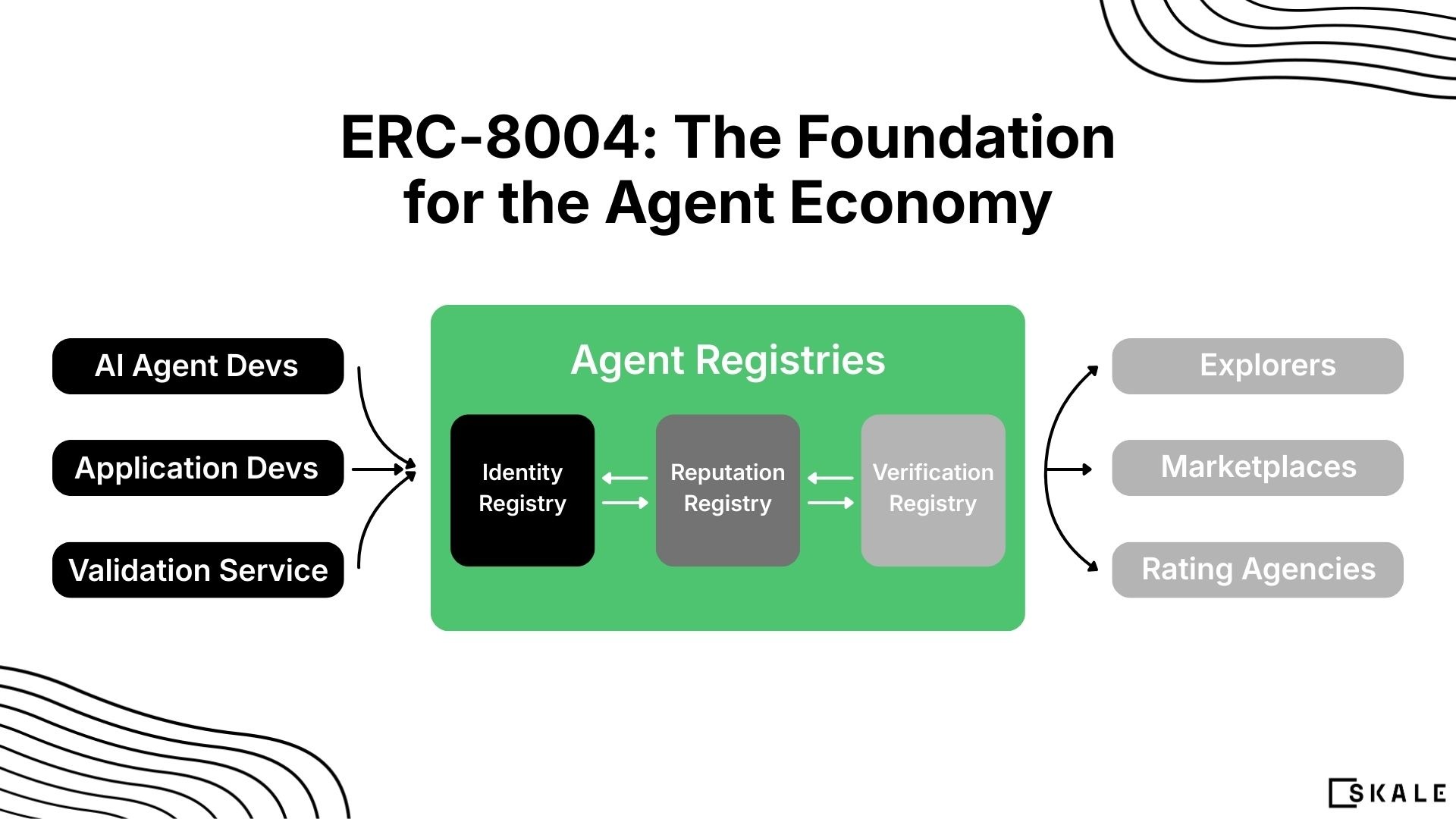
ERC-8004 is a standard that extends the Agent-to-Agent (A2A) Protocol by introducing a decentralized trust layer for autonomous agents. While A2A defines how agents communicate, ERC-8004 defines how they discover, authenticate, and trust one another without centralized intermediaries.
It achieves this through three lightweight, onchain registries that work together to create a verifiable reputation system:
- Identity Registry: Assigns each agent a unique, persistent onchain identity (ERC-721). This acts as a "passport" that anchors the agent's off-chain capabilities and metadata (Agent Card), making them discoverable across the network.
- Reputation Registry: A decentralized feedback system where agents can log verifiable reviews of their interactions. This creates a transparent, immutable track record of an agent's reliability.
- Validation Registry: A framework for third-party verification of agent tasks. It supports advanced cryptographic proofs, including Trusted Execution Environments (TEEs), Zero-Knowledge (ZK) proofs, and crypto-economic staking, to mathematically prove an agent performed work correctly.
By combining these three primitives, ERC-8004 transforms agents from isolated scripts into verifiable economic actors that can safely collaborate in a trustless environment.
How ERC-8004 is Used in Practice
In a live environment, ERC-8004 functions as the operating system for agent trust. Instead of developers manually hardcoding trust assumptions, agents use the protocol to autonomously vet counterparts and build their own track records.
The practical lifecycle of an ERC-8004 interaction follows a standardized loop:
- Registration & Discovery: An agent registers in the Identity Registry, minting a unique ID that links to its off-chain capabilities profile (Agent Card). This makes the agent globally discoverable to other software without relying on a centralized directory.
- Verification: Before engaging, a client agent checks the Validation Registry to confirm the provider's claims (e.g., verifying a TEE attestation or a staked security bond) and reviews the Reputation Registry for historical performance.
- Execution: The agents interact off-chain (e.g., API calls, data processing) to perform the task.
- Reputation Settlement: Once complete, the client logs the outcome in the Reputation Registry. This permanently updates the provider's public trust score, often including a proof of payment to prevent spam.
This loop allows the ecosystem to compose naturally, with agents continuously filtering for high-reputation peers without human intervention.
The Problem: Gas Limits Agent Autonomy
Before understanding the solution, we must look at the limitations currently being discussed in the developer community. As highlighted in recent Ethereum Magicians threads, the current gas model presents a fundamental barrier to autonomous agents.
The core issue is that agents on mainnet must constantly manage a volatile "fuel" supply (ETH) just to exist and interact. If an agent needs to perform thousands of micro-validations or reputation updates, the gas costs quickly exceed the value of the work itself. Furthermore, gas spikes can paralyze an agent, forcing it to shut down or fail tasks simply because the network is congested. This economic friction makes true "always-on" autonomy impossible on traditional fee-market chains.
The Economic Fix: Cost Stability Without Gas Anxiety
SKALE solves the gas problem not through a subsidy, but through a unique credits-based usage model.
Agents often need to fire thousands of tiny actions, messages, and payments. On traditional gas models, many of those steps are too expensive to justify. On SKALE on Base, agents and users do not pay gas for each transaction.
- For the Operator: Applications and operators pre-pay for credits on Base using USDC or SKL. These credits map to compute capacity on SKALE and are consumed as agents run, offering a predictable, usage-based model similar to AI or cloud platforms.
- For the Agent: Zero gas fees at the transaction level make high-volume microtransactions and dense x402 flows practical. This allows fleets to scale from early experiments to large, always-on operations without the friction of managing gas balances per wallet.
This transforms agent economics from a "pay-per-step" model to a sustainable "pay-for-compute" model, essential for high-frequency agent interactions.
How ERC-8004 Benefits From Onchain Privacy (BITE)
ERC-8004 is most powerful when its trust updates are cheap and continuous, but that also makes the pattern of those updates sensitive. If every identity, reputation, and validation event is written through a fully transparent mempool, other agents or adversaries can watch which agents are being queried, how reputations shift over time, and where high-value activity is clustering.
SKALE integrates BITE (Blockchain Integrated Threshold Encryption) to solve this. BITE allows transactions to be encrypted before they enter the mempool and only decrypted after they are finalized in a block.
This enhances Identity Protection specifically by preventing "pre-trade" surveillance. An agent can verify its identity or check another agent's reputation without broadcasting that interest to the entire network until the action is already complete. This lets agents record feedback, validations, and payment-linked outcomes without leaking their strategies or relationships in real-time.
SKALE: Gasless, Private, Instant Execution Layer for Agents
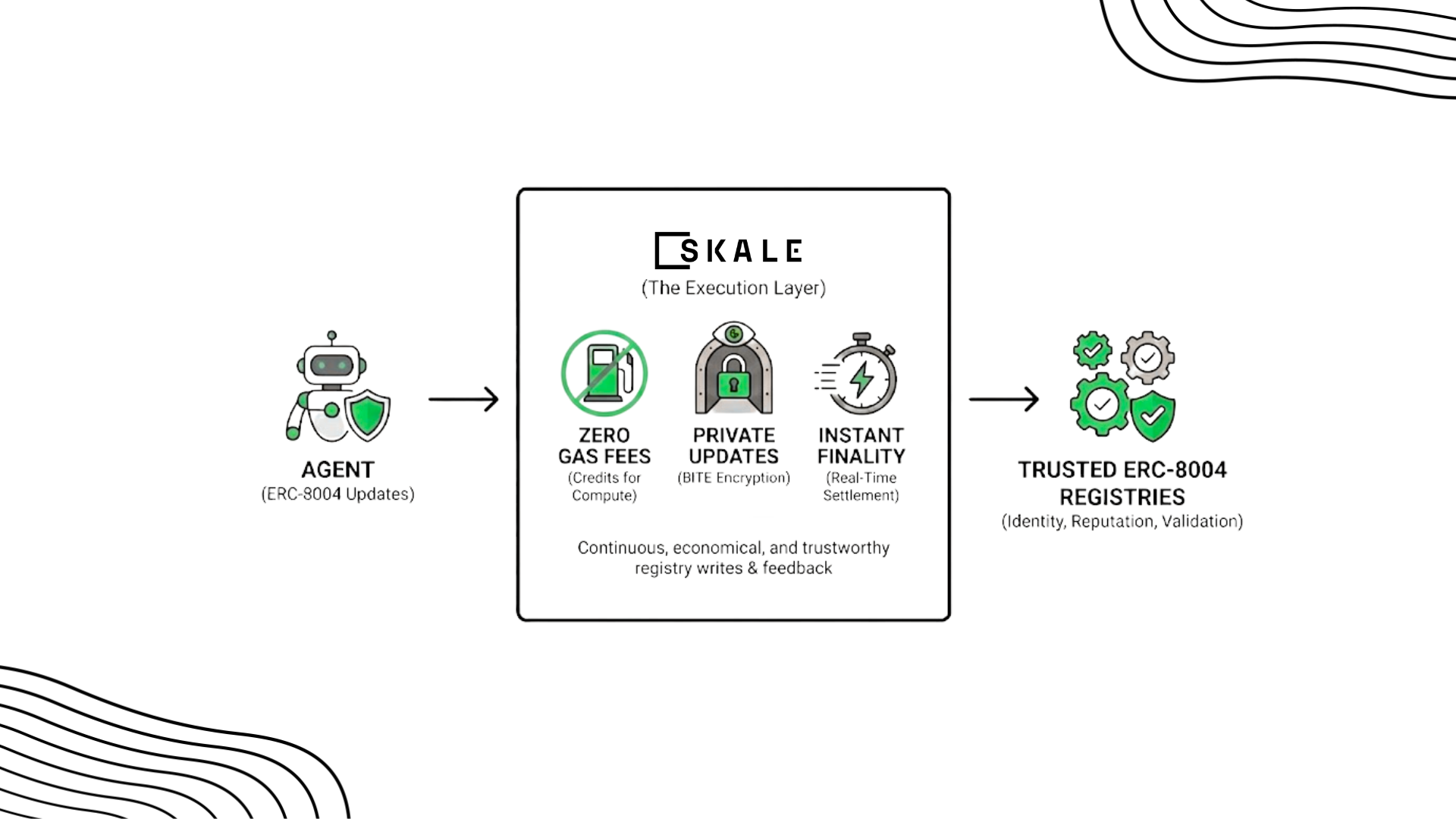
ERC-8004 shines when agents write small updates often (ratings, receipts, validations). That’s expensive, slow, and exposes sensitive information on most chains. SKALE fixes this with:
- Encrypted trust updates: ERC-8004 calls into the Identity, Reputation, and Validation registries run over BITE-encrypted transactions.
- Zero gas fees for continuous writes: Enabled by App Chain Pricing, agents can log every rating and receipt without juggling gas.
- Instant finality: Trust data settles instantly, allowing systems to react to new feedback immediately.
- Room to scale: SKALE removes limitations on agent registration volume. Recognizing that nothing is infinitely scalable, the network allows specific agent registries or markets to run on their own dedicated chains. This ensures that individual high-volume use cases have the dedicated resources they need without creating bottlenecks for the wider ecosystem.
Benefits to Agents
By standardizing trust and identity, ERC-8004 provides the necessary infrastructure for agents to evolve from isolated scripts to interconnected economic actors.
Enhancing Agent-to-Agent (A2A) Protocols
While protocols like A2A define how agents communicate (the messaging layer), they often lack a universal standard for who is communicating. ERC-8004 acts as the missing identity layer for A2A, allowing agents to discover one another across open networks rather than relying on closed, centralized directories. By querying the Identity Registry, an agent can instantly resolve an A2A endpoint, verify the counterparty's metadata, and establish a connection, making the "Internet of Agents" truly interoperable.
Enabling Deterministic Action via Reputation
Autonomous agents cannot rely on intuition; they require structured, verifiable data to determine their next actions. To autonomously decide whether to hire a service or accept a task, an agent needs "certain information"—specifically, a verifiable track record. The Reputation and Validation registries provide this data in a machine-readable format. Whether it is a high reputation score or a cryptographic proof of past performance, these onchain signals allow agents to programmatically assess risk and execute transactions with confidence.
Conclusion
ERC-8004 gives builders a shared, minimal trust layer for autonomous agents. SKALE supplies the privacy and performance to use it on every interaction, not just the big ones. If you’re exploring agent infrastructure or machine-to-machine coordination, ERC-8004 on SKALE is the stack: simple onchain trust, gasless writes, and room to scale.
%202.png)


.svg)
.svg)

