
.webp)
.webp)
.webp)
BITE Protocol: Bringing Commerce-Level Privacy to Agentic Payments on SKALE

%20(1).png)
TL;DR
- On most blockchains, payments are fully transparent, which can leak balances, spending patterns, counterparties, and operational strategy.
- That transparency creates real risk: unintended financial disclosure, loss of competitive edge, and increased susceptibility to MEV and adversarial behavior.
- SKALE solves this with BITE (Blockchain Integrated Threshold Encryption), bringing privacy to onchain payments without breaking verifiability.
- BITE enables private agentic payments via: shielded balances, conditional/autonomous transactions, and encrypted execution that hides intent.
- SKALE is ideal for agentic payments because it combines BITE privacy with instant finality and scalable, zero-gas throughput.
The Shift to Agentic Payments
AI agents are quickly moving from demos to real work. They’re already being used to monitor data, run research, handle support tickets, manage marketing ops, and execute repetitive workflows across tools and APIs. As they take on more responsibilities, they also need a way to operate economically in the real world: to purchase data, pay for compute, access software services, and settle transactions with other agents or businesses.
That’s what agentic payments unlock. Instead of routing every purchase through a human checkout flow, an agent can be given a budget and a set of rules, then pay for what it needs as it goes. The result is a shift from static subscriptions and manual billing to dynamic, usage-based commerce where software can transact in real time, at scale.
The problem: On Most chains, Payments are a Full Financial Disclosure
On typical public blockchains, agentic payments inherit the default transparency of the base layer. Every payment is visible in a block explorer. That sounds fine until you realize what a payment reveals in practice:
1) Unintended financial disclosures
A simple payment can leak far more than what’s needed to complete the transaction: wallet balances, funding sources, and transaction history. For autonomous agents, this is especially dangerous because their wallets can represent business logic, budgets, counterparties, and operational patterns.
2) Loss of Competitive Edge
If a procurement agent is paying a vendor, or a trading agent is paying for data feeds, those payments can reveal what the agent is doing and why. Observers can reverse engineer strategies from where money goes, how often, and in what size.
3) Susceptibility to MEV and adversarial behavior
When intent is readable, it can be exploited. If payments are coupled with downstream onchain actions (swaps, trades, liquidations, inventory purchases, arbitrage, bidding), transparent transaction data gives searchers and competitors a blueprint to front-run, sandwich, or otherwise interfere.
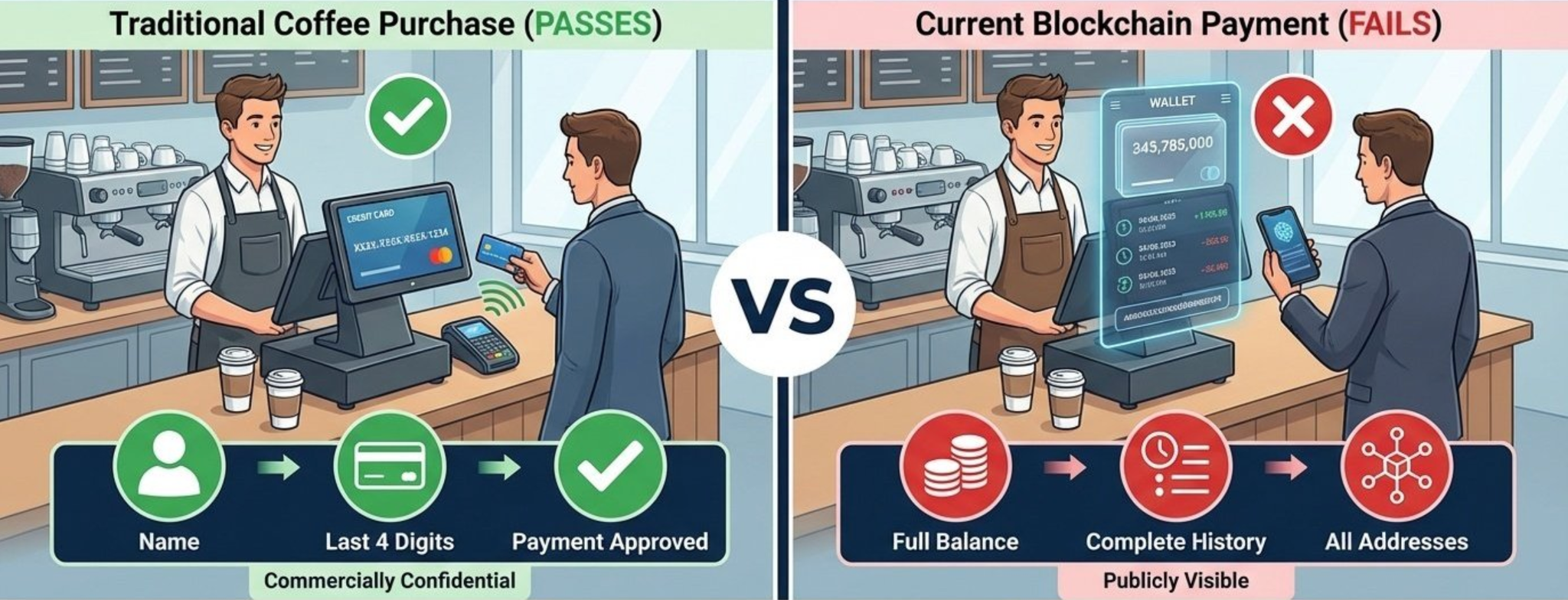
The “Barista Test” (why transparency breaks normal commerce)
In the real world, buying a coffee with a debit card reveals almost nothing. The barista sees “Approved.” They do not see your net worth, where your paycheck comes from, or your last five purchases.
Most blockchains fail this test. If an agent buys coffee (or anything) with a transparent onchain payment, the recipient and the entire internet can often infer far more than the transaction itself should reveal. SKALE’s approach is designed to pass this barista test: confirm the payment, keep the rest private.
The Solution: SKALE’s BITE Protocol For Private Agentic Payments
SKALE’s answer is BITE (Blockchain Integrated Threshold Encryption), a privacy layer designed for agentic commerce. BITE’s goal is straightforward: let agents move value with the same commercial confidentiality and programmability we expect from modern payments, while keeping settlement verifiable onchain.
BITE’s core features for private agentic payments on SKALE include:
Private transactions with Shielded Balances
BITE allows tokens to be sent and received while keeping amounts and wallet balances encrypted. Agents make payments that are frequent, granular, and machine-driven. If each one is public, the payment stream becomes a surveillance feed: budget, usage, vendor relationships, and activity patterns. With shielded balances, only the information required for the transaction at hand is exposed, not the payer’s full financial profile.
Back to the barista test: the service provider should be able to verify that payment happened, without learning the agent’s full treasury posture.
Encrypted Execution
BITE can keep transaction inputs encrypted until execution, so observers cannot read the agent’s intent from public transaction data. Even if you hide amounts, intent can still leak via call data and parameters. Encrypted execution aims to keep sensitive details private, like:
- price thresholds
- risk limits
- identity or credential checks
- strategy parameters for trading or treasury management
This directly reduces “intent leakage,” which is often the root cause of MEV exploitation and strategy copycats. Observers can see that something happened onchain, without seeing the private commercial logic that made it happen.
Bonus: Conditional and Autonomous Transactions
BITE supports native “if/then” financial flows that trigger only after a specified condition or state change, including conditions that involve decryption events. The most powerful version of agentic payments are not just “pay to access,” it’s “pay as part of a workflow.” Agents increasingly need to run multi-step sequences without babysitting every step.
BITE’s conditional transactions move agents from one-off payments to fully autonomous execution, enforced by the chain instead of a human operator or a centralized scheduler.
%20(2).png)
Use Cases for Private Agentic Payments
Privacy is not a “nice to have” when payment streams describe behavior. Here are agentic payment use cases where BITE-style confidentiality changes what’s possible:
Agent Resource Consumption
Agents buying GPU-minutes, storage, or specialized inference can inadvertently reveal what workloads they run based on where money goes, how often, and in what size. Privacy helps keep internal operations, model usage patterns, and demand signals confidential.
Market data and trading agents
A trading agent paying for specific data feeds, execution routes, or onchain actions can leak what it is watching and when it is about to act. Pair privacy with conditional flows and encrypted execution, and you reduce strategy leakage and adversarial interference.
Agentic Commerce
Agents are increasingly intermediating consumer spend, from purchasing content to paying for tools and services on a user’s behalf. Transparent payments can expose financial history, consumption habits and personal interests. Private transactions enable “pay as you go” experiences without turning behavior into public metadata.
Why SKALE For Agentic Payments
In addition to transactional privacy from BITE Protocol, SKALE has several other architectural features that make it the ideal blockchain for agentic payments:
Zero Gas Fees That Keep Micropayments Truly Micro
As more agents come onchain, transaction counts will go up while transaction sizes go down, meaning more frequent and lower-value micropayments. That only works if per-transaction overhead does not kill the economics. SKALE’s zero-gas model removes per-transaction fees, so micropayments stay truly micro even at high frequency. Instead of gas, agent transactions on SKALE are powered by credits, similar to how other AI resources are provisioned and consumed.
Horizontal Scalability Through More SKALE Chains
Agentic payment systems also need throughput that can grow as usage grows without everyone competing for a single shared blockspace. SKALE’s multi-chain architecture scales horizontally by letting applications deploy more SKALE Chains as demand increases, rather than bottlenecking on one chain. With SKALE Expand, builders can add capacity by spinning up additional SKALE Chains to match rising transaction volume and keep performance predictable as agent activity ramps.
The Next Step for Onchain Agents is Private by Default
SKALE’s BITE protocol points to the next phase of agentic commerce: private, autonomous, verifiable payments that pass the barista test while still settling onchain. Combine that with SKALE’s instant finality and scalable, zero-gas throughput, and you get a chain that is not just ready for agentic payments, but could be the execution layer for the machine economy.


.svg)
.svg)

